BTE Hearing Aid Fitting Case
For hearing aid distributors, hearing care providers, and professional partners, choosing the right device is not simply a matter of selecting a model with sufficient amplification. The hearing condition, listening environment, fitting strategy, and follow-up support all influence the final user experience.
This real-world case follows a 58-year-old man who had experienced hearing difficulties for more than 20 years.
After professional hearing assessment, an initial device trial, further comparison, and personalized fitting, he ultimately selected a pair of LW8-BTE-P hearing aids.
The case demonstrates why power, speech clarity, real-world listening performance, and professional fitting support are especially important when serving users with significant hearing loss.
More Than 20 Years of Hearing Difficulty
The user worked at a seafood stall in a busy wholesale market, an environment filled with voices, equipment noise, and constant communication.
However, much of that sound had gradually become difficult for him to hear.
His hearing problems began much earlier in life. He had undergone ear surgery as a teenager and later experienced recurrent middle-ear problems. Over the following decades, his hearing continued to decline.
By the time he sought professional support, the hearing difficulty had significantly affected both his work and family communication.
Watching mobile videos required very high volume. Family members often had to raise their voices when speaking with him. At work, quieter instructions from colleagues were easy to miss.
His goal was straightforward:
to hear his family and coworkers more clearly and communicate with less effort.
For hearing care professionals, understanding this real-world goal is just as important as reviewing an audiogram.

Professional Hearing Assessment Before Fitting
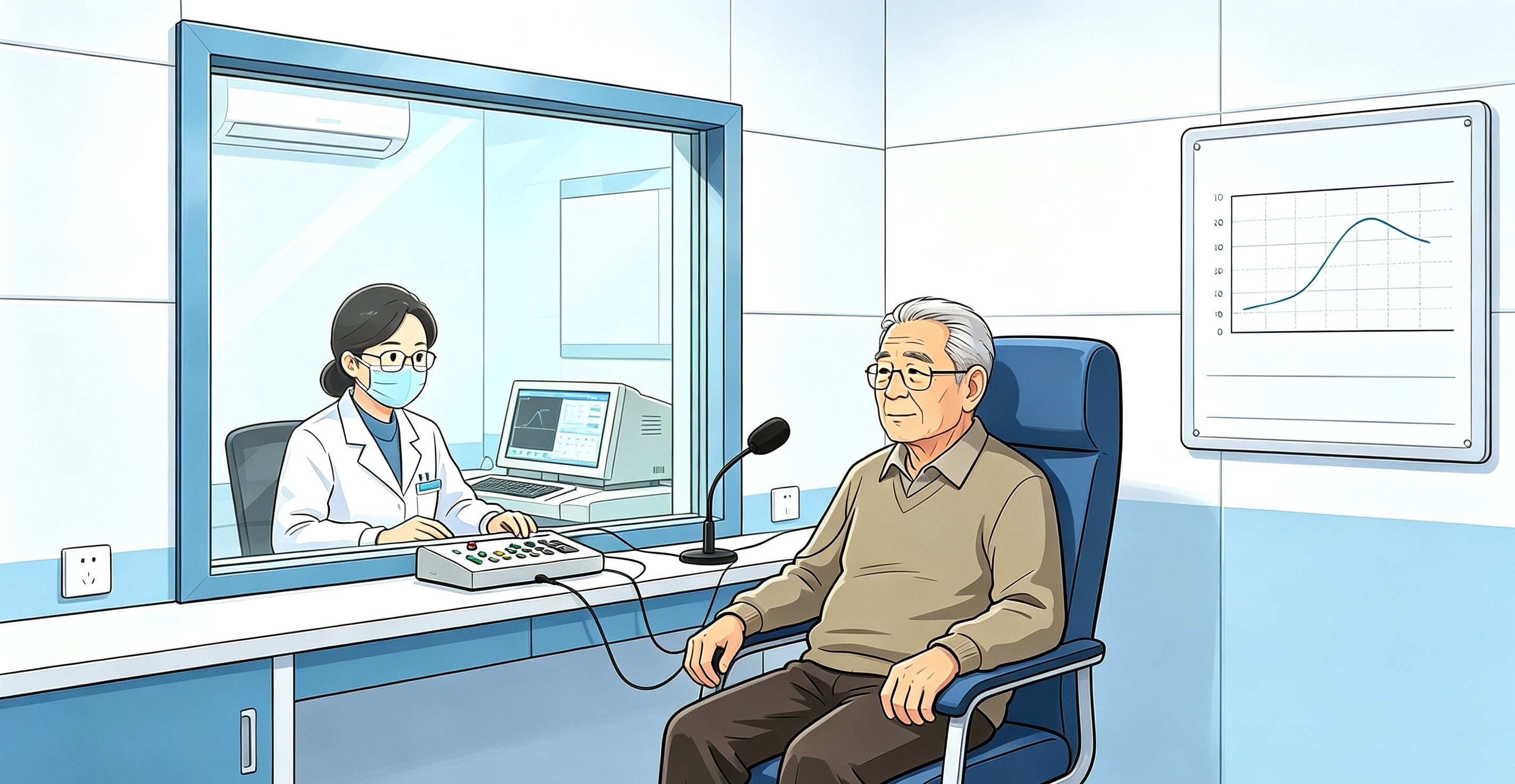
Before selecting a hearing aid, the fitting team carried out a comprehensive assessment.
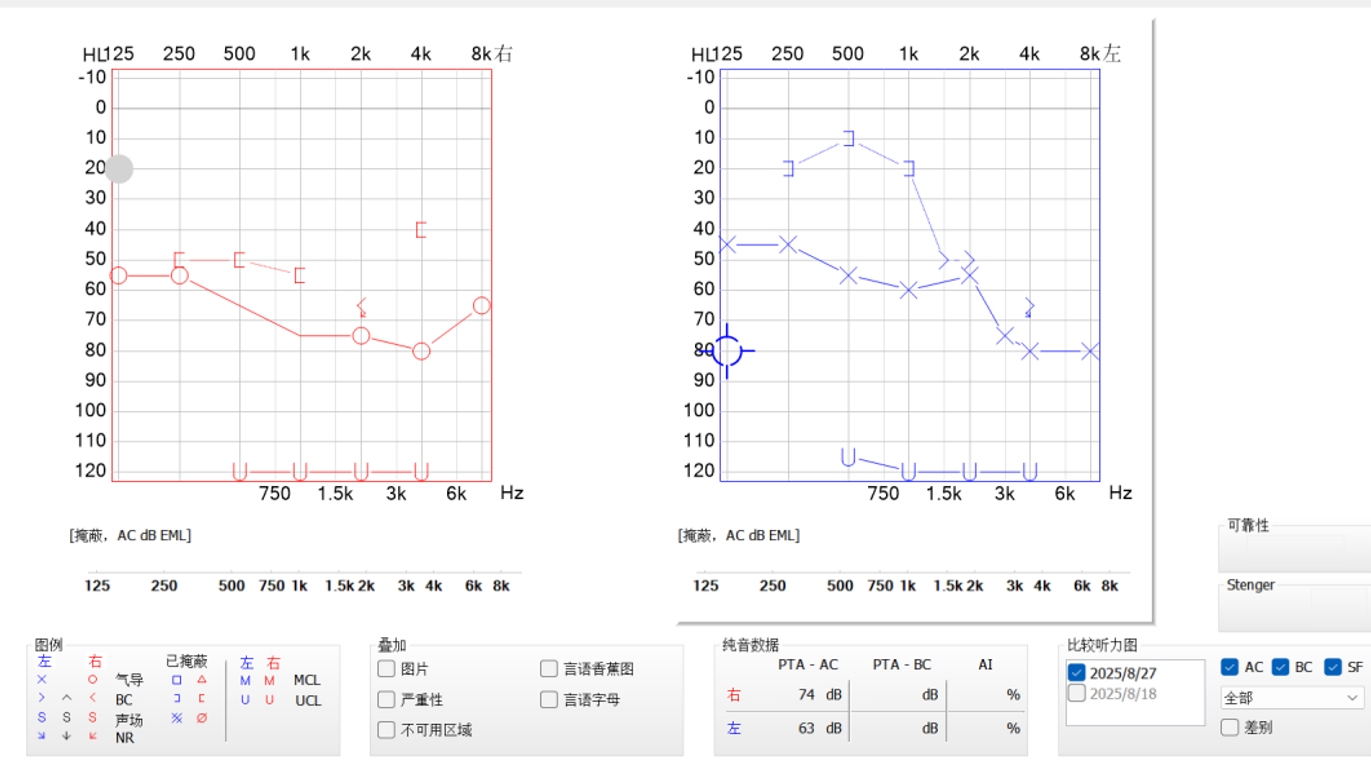
Otoscopy showed abnormal findings consistent with his previous ear history, while pure-tone audiometry indicated significant bilateral hearing loss.
The measured pure-tone averages were:
Left ear: PTA 63 dB
Right ear: PTA 74 dB
The overall results indicated moderate-to-severe hearing loss in the left ear and severe hearing loss in the right ear, with a mixed hearing loss pattern.
These results immediately influenced product selection.
For users with greater hearing loss, a hearing aid needs sufficient output and fitting headroom while still maintaining speech clarity and listening comfort.
This is one reason professional BTE hearing aid fitting remains important for users who require higher amplification.
The First Trial Was Not the Final Answer
The user initially tried another hearing device.
Although the device offered a modern form factor and wireless functionality, the real-world trial revealed several problems.
When riding an electric bicycle, wind noise was too noticeable.
His own voice produced an uncomfortable echo.
Most importantly, speech from other people was still not clear enough.
This feedback became an important part of the fitting process.
A product may appear suitable based on features or initial specifications, but real-world listening can reveal whether the device truly meets the user's needs.
For this user, additional functions were less important than one fundamental requirement:
clear speech.
Rather than asking him to accept an unsatisfactory listening experience, the fitting professional continued evaluating other options.
Selecting the LW8-BTE-P for Greater Power
The fitting professional explained that smaller in-ear options could be considered, but their available power would not adequately match the user's degree of hearing loss.
A higher-power BTE solution was therefore evaluated.
The user then tried the LW8-BTE-P.
Compared with the previous option, the device provided the power level and speech clarity he was looking for.
After comparing the listening experience and considering his daily communication needs, he selected two LW8-BTE-P hearing aids for bilateral use.
This part of the case highlights an important principle in hearing aid selection:
Form factor should not take priority over appropriate power and usable speech performance.
For distributors and hearing care providers, having different product categories available makes it possible to match hearing aids more accurately to varying degrees and types of hearing loss.

BTE Hearing Aid Fitting and User Training
Product selection was only the beginning.
After the devices were fitted, the user received practical guidance on how to use them correctly.
The fitting team explained proper wearing procedures, battery replacement, volume adjustment, and everyday handling.
A four-week adaptation plan was also introduced to help the user gradually become familiar with amplified sound.
This type of structured adaptation is particularly valuable for people who have lived with significant hearing loss for many years.
Their auditory system and listening habits may require time to adjust to sounds that have been absent or reduced for a long period.
Professional BTE hearing aid fitting therefore involves both technical programming and user education.
For hearing care providers, the goal is not simply to deliver a device. It is to help the user understand how to use it effectively in daily life.
Follow-Up Support After Delivery
The service team continued to follow the user's progress after the initial fitting.
A telephone follow-up was carried out seven days later.
By that time, he had already become more familiar with device operation.
Questions related to product value, policy support, and continued use were also discussed during follow-up communication.
The longer-term feedback was more significant.
His communication gradually became clearer and easier.
In the wholesale market, he was better able to hear coworkers.
At home, family members no longer needed to raise their voices as much during everyday conversations.
For someone who had struggled with hearing for approximately two decades, this represented a meaningful improvement in daily communication.
The case also reinforces why after-sales support should remain part of the hearing aid fitting process.

Why High-Power BTE Solutions Matter
Different hearing losses require different product strategies.
For mild or moderate hearing needs, smaller form factors may provide sufficient performance.
For users requiring greater amplification, however, power reserve, stable output, fitting flexibility, and speech clarity become increasingly important.
BTE hearing aids remain an important product category because they can support users with more demanding amplification requirements.
For professional partners, the value of a high-power BTE solution is not based on output alone.
The complete experience also depends on:
accurate hearing assessment;
appropriate product selection;
bilateral or unilateral fitting decisions;
parameter adjustment;
wearing and maintenance guidance;
adaptation planning;
follow-up support.
A strong product portfolio should therefore support both technical fitting requirements and real-world service workflows.
What This Case Means for B2B Partners
For hearing aid distributors, importers, clinics, and brands, real-world fitting cases provide insights that technical specifications alone cannot fully communicate.
This case shows why a user may reject one device even when it has attractive functions, while responding positively to another product that better addresses the core hearing requirement.
It also demonstrates the importance of offering different power levels and form factors for different user groups.
AcoSound develops hearing aid solutions for professional markets and works with partners serving a wide range of hearing needs.
The LW8-BTE-P represents a BTE solution intended for applications where greater amplification and practical fitting flexibility are important considerations.
For business partners, this type of product can complement RIC, ITE, and other hearing aid categories within a broader portfolio.
AcoSound also supports distribution, OEM, ODM, private-label, and customized cooperation based on different target markets and business requirements.
Real-world fitting experience helps connect product development with the needs of hearing care professionals and end users.
Building Value Beyond the Device
A successful hearing aid experience depends on more than hardware.
The product must first be suitable for the user's hearing condition.
It must then be programmed correctly, introduced with appropriate user education, and supported through the adaptation period.
This case moved through each of those stages:
assessment → trial → comparison → product selection → fitting → adaptation → follow-up.
That complete process is what turns technical hearing aid performance into practical everyday value.
For AcoSound and its professional partners, the objective is not simply to provide more devices, but to support hearing solutions that can be effectively fitted and used in real-world environments.
Professional fitting helps the right hearing aid deliver the right value to the right user.
Looking for a BTE Hearing Aid Partner?
If you are a hearing aid distributor, importer, hearing care provider, or brand looking for BTE hearing aids and flexible cooperation options, AcoSound welcomes opportunities for long-term partnership.
Contact AcoSound to discuss BTE product requirements, target markets, OEM/ODM projects, or customized hearing aid solutions.
Contact AcoSound to Start a Conversation
 EN
EN