EN

Hearing Aid Fitting Software: PC-Based vs. App-Based Solutions
2026/11/11
Explore hearing aid fitting software. Compare PC fitting with app-based options, compatibility, professional workflows, plus distributor needs.
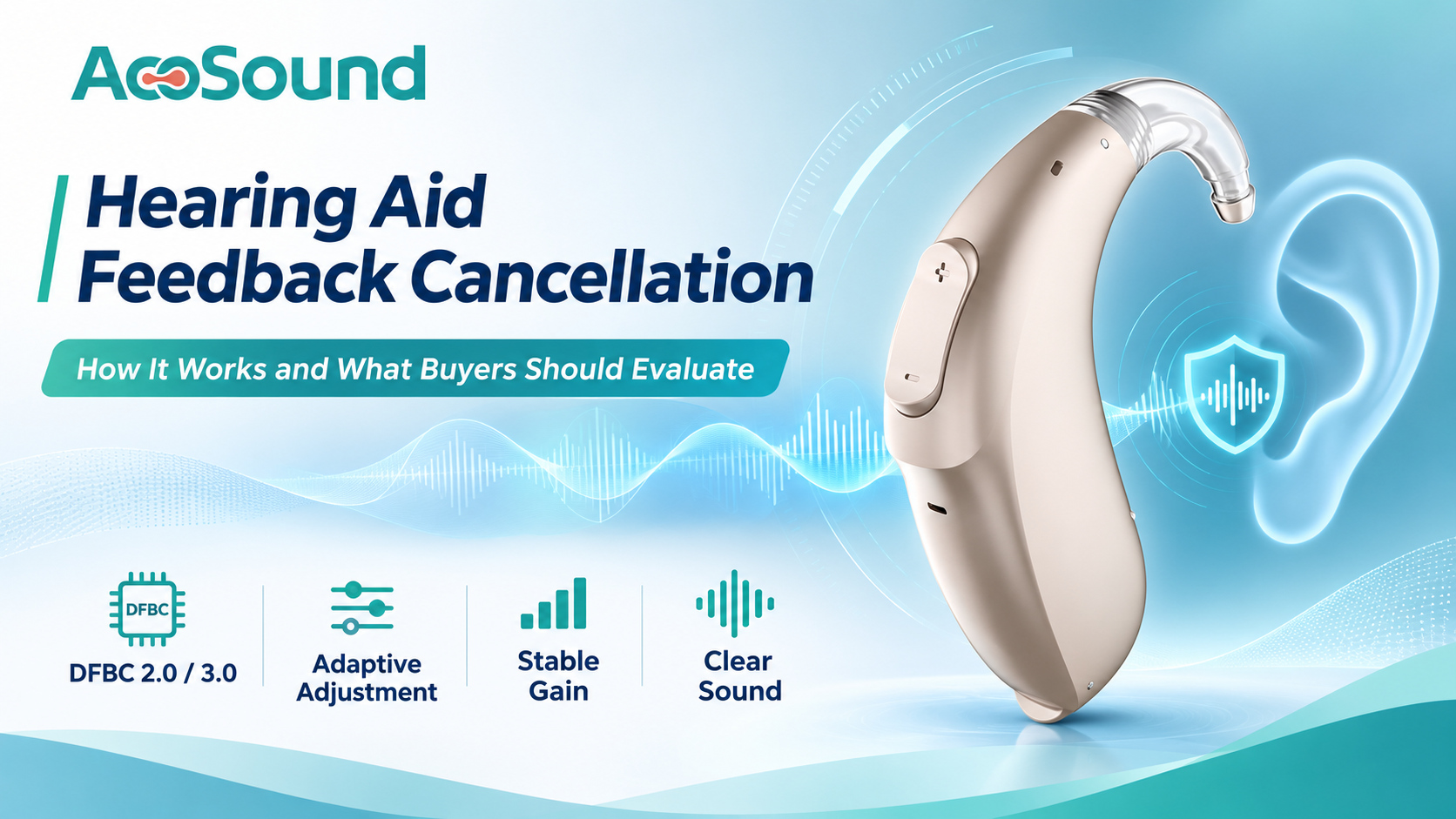
Hearing aid feedback is often heard as a high-pitched whistle. It can occur when sound from the receiver leaks out of the ear, returns to the microphone, and is amplified again. For hearing aid distributors and hearing care professionals, feedback control is an important product feature to evaluate.
This guide explains how hearing aid feedback cancellation works and what buyers should consider when comparing digital hearing aids from different manufacturers.
A hearing aid contains microphones, digital processing, and a receiver. When amplified sound from the receiver travels back to the microphone, it can create an acoustic feedback loop. If the loop becomes unstable at a particular frequency, the user may hear whistling or howling.
Possible contributing factors include:
A loose or poorly fitted dome or earmold.
Acoustic leakage around the earpiece.
A change in the position of the hearing aid.
High gain under a particular fitting configuration.
Earwax, damaged tubing, or unsuitable acoustic components.
Feedback is not always evidence of an electronic fault. Physical fit, acoustic coupling, and device settings should also be checked. For product buyers, hearing aid feedback cancellation should therefore be assessed alongside physical fit and acoustic coupling. Effective hearing aid feedback management also considers the fit, the acoustic path, and the device's processing strategy.
Many digital hearing aids use feedback cancellation algorithms to estimate the sound that travels from the receiver back to the microphone. A hearing aid feedback cancellation system does not simply turn down all amplification; its purpose is to estimate and reduce the unwanted feedback component.
A common approach uses an adaptive filter to model the feedback path. The hearing aid generates an estimate of the unwanted feedback component and subtracts it from the microphone signal.
The filter can update as the acoustic path changes, for example when the wearer moves a hand or telephone close to the ear.
The goal is to reduce unwanted feedback while retaining useful incoming sound. Actual performance depends on the algorithm, device design, fitting, and acoustic conditions.
Some devices also use other feedback-management methods, such as reducing gain in affected frequency regions. These methods may be combined with adaptive cancellation. In practice, feedback cancellation technology should be evaluated as part of the complete signal-processing system.
These approaches are related, but they are not identical.
| Approach | How It Works | What Buyers Should Check |
|---|---|---|
| Gain Reduction | Lowers amplification in affected frequency regions | Whether usable gain is reduced |
| Adaptive Feedback Cancellation | Estimates the feedback path and subtracts an estimated feedback signal | How the system responds when acoustic conditions change |
| Combined Feedback Management | Uses cancellation together with other control methods | Which methods are available on each model |
Do not assume that every manufacturer uses the same architecture or that a feature name guarantees a particular result.
When comparing hearing aid feedback cancellation features, distributors should evaluate both the technology and the fitting conditions in which it operates.
Ask the manufacturer whether the product uses adaptive feedback cancellation, gain management, or a combination. Request a clear explanation of how the technology operates and whether it is model-specific.
Confirm which models include the feature, whether different configurations are available, and whether fitting software allows relevant settings to be reviewed or adjusted.
Do not assume that every model in a product family has the same configuration.
Feedback performance depends partly on acoustic fit. Ask whether the fitting workflow includes feedback-path measurement or calibration, and request the relevant fitting instructions.
The acoustic path can change when a wearer adjusts the hearing aid or moves a hand near the ear.
Ask how the system responds to these changes and whether the manufacturer has supporting test information.
Feedback cancellation should be assessed alongside sound quality. Some algorithms may produce audible artifacts under particular conditions, including with tonal or music signals.
Buyers should evaluate speech, music, and changing listening environments rather than relying only on a feature label.
Receiver type, dome size, earmold design, and venting affect acoustic coupling.
Check available accessories, compatibility, and replacement procedures. A suitable physical fit remains important even when feedback cancellation is available.
A practical hearing aid feedback cancellation evaluation should combine documentation review with sample testing. Before placing a wholesale order, distributors can request samples and review the following:
Confirm the exact model and feedback-management configuration.
Complete fitting and recommended calibration.
Check the fit with supplied domes or earmolds.
Observe feedback behavior during normal handling and movement.
Evaluate speech and music playback.
Review fitting software and technical documentation.
Confirm replacement receivers and accessories are available.
Where possible, ask the manufacturer for test methods and supporting technical data. Comparisons are more meaningful when products are evaluated under consistent conditions.
AcoSound's published product information lists different feedback-cancellation configurations across selected hearing aid models, including DFBC 2.0 and DFBC 3.0 options. AcoSound's hearing aid feedback cancellation configurations and available functions vary by model.
Availability and configuration vary by model.
These technologies are part of AcoSound's broader digital sound-processing platform.
For distributors, the important consideration is to compare feedback management together with fitting channels, adjustable bands, DSP processing, receiver options, and other sound-processing functions.
No single feature should be used as the sole measure of overall hearing aid performance.
Buyers should refer to the corresponding product datasheets to confirm the latest model-specific specifications.
A reliable supplier should explain how hearing aid feedback cancellation is implemented in each model and provide the corresponding specifications. Feedback cancellation is only one part of a complete hearing aid platform.
When selecting a manufacturing partner, distributors should also consider:
In-house technology development.
Product range and model configurations.
Sound-processing capabilities.
Manufacturing and quality management.
OEM and ODM customization.
Fitting software and APP support.
Spare parts and after-sales service.
Professional technical assistance.
A manufacturer that provides clear technical documentation and consistent product support can make long-term cooperation easier to manage.
No. It is designed to reduce acoustic feedback, but it cannot guarantee that whistling will never occur. Fit, acoustic leakage, gain settings, and device condition still matter.
No. Adaptive cancellation estimates and subtracts an unwanted feedback component. Gain reduction lowers amplification in selected conditions or frequency regions. Some devices combine both approaches.
It can, depending on the algorithm and signal conditions. Evaluation should include speech and music because some tonal signals can challenge feedback-cancellation systems.
Ask which models support the function, how it works, whether calibration is required, how performance is evaluated, and what fitting software, accessories, and technical support are provided.
AcoSound develops and manufactures digital hearing aids for distributors, importers, hearing care businesses, and private-label brands.
Our product portfolio includes different sound-processing and feedback-management configurations, with OEM and ODM support for suitable projects.
Explore our hearing aid products, learn about OEM and ODM solutions, or contact our team to discuss your product requirements.
2026/11/11
Explore hearing aid fitting software. Compare PC fitting with app-based options, compatibility, professional workflows, plus distributor needs.

2026/11/06
Explore hearing aid technology, remote fitting, AI-assisted interaction and AcoLink connectivity for hearing care professionals and global distributors.

2026/11/04
Explore key considerations for distributors selecting hearing aids for seniors, from BTE and RIC styles to usability, power options and after-sales support.
2026/11/02
A practical guide to Bluetooth hearing aid functions, app control, audio streaming, phone compatibility and supplier checks for distributors.