EN

How to Choose a Reliable Hearing Aid Distributor for Long-Term Business Growth?
2026/10/29
Struggling with unreliable suppliers? Discover 10 proven criteria to evaluate hearing aid distributors. Start choosing strategically today.
2026/11/02
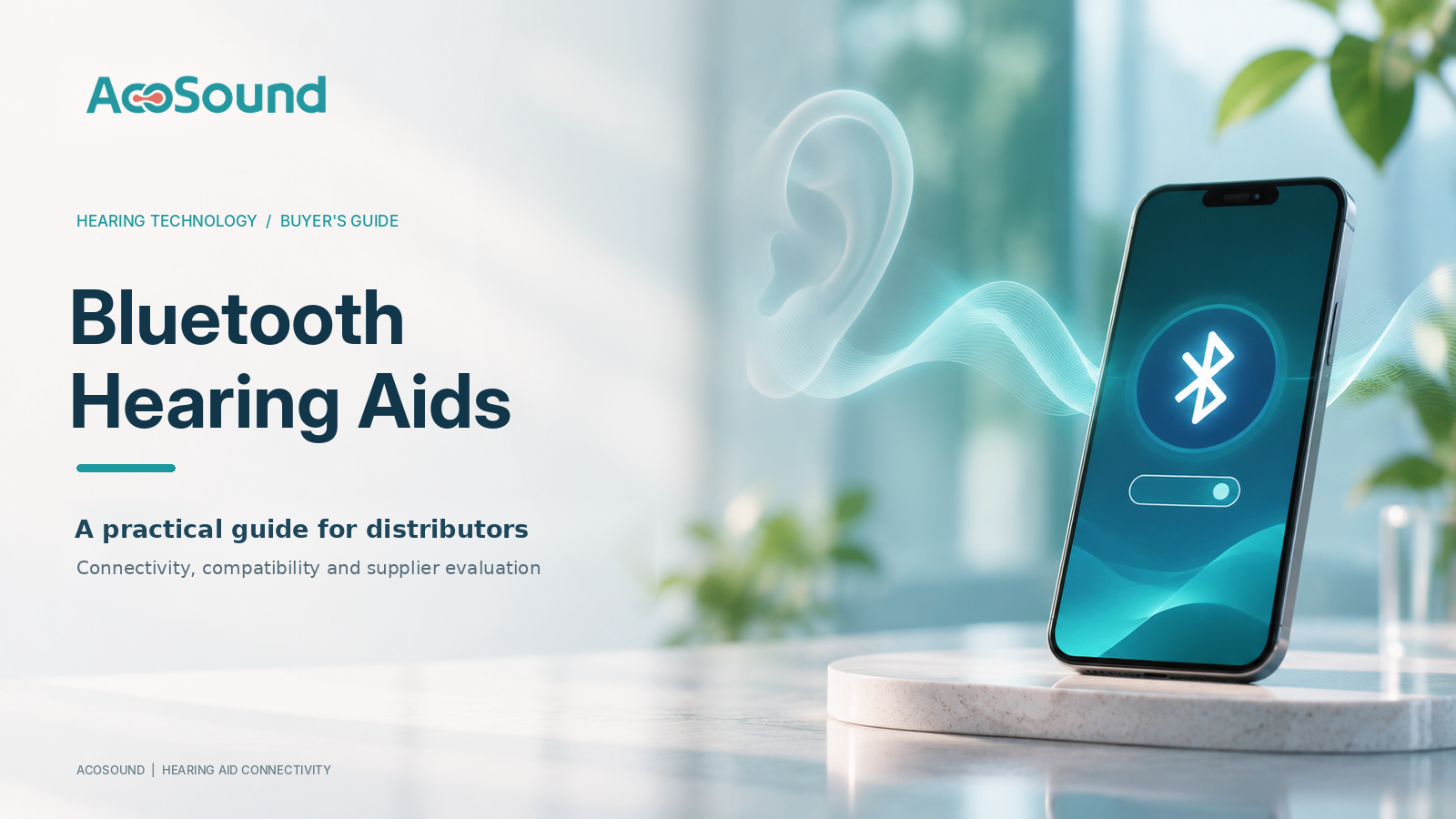
Bluetooth connectivity is an important consideration when distributors compare hearing aid models. Yet the phrase “Bluetooth enabled” does not tell buyers exactly what a product can do. A Bluetooth hearing aid may connect to a companion app, support direct audio streaming, or offer both. These capabilities are not interchangeable.
For importers, distributors and procurement teams, the key questions are practical: Which functions are included? Which phones and operating systems are supported? What has been tested, and what documentation can the supplier provide?
This guide explains how to evaluate a Bluetooth hearing aid at model level, compare products accurately and reduce compatibility surprises.
Bluetooth features vary by model. Some devices connect to a companion app, while others may also receive audio directly from a phone or another source. Confirm each function separately rather than treating “Bluetooth” as a complete feature description.
App control may allow users to adjust volume, change listening programs, review device status or access other settings. The available controls depend on the hearing aid, its firmware and the manufacturer’s app. A hearing aid app should therefore be reviewed on the exact model being quoted. When assessing a Bluetooth hearing aid, ask the supplier to demonstrate its actual app functions.
Direct audio streaming is a separate capability. Depending on the model and supported connection method, audio such as phone calls, music or other media may be sent from a compatible device to the hearing aids. Call handling and microphone return audio should also be checked separately: receiving audio does not automatically mean that hands-free, two-way calling is supported.
For product comparisons, list app pairing, remote adjustments, call audio, media streaming, hands-free calls and accessory connections separately. Mark each item as supported, not supported or unverified. This makes each Bluetooth hearing aid easier to explain and avoids creating expectations the product may not meet.
Hearing aid compatibility depends on the device’s wireless implementation, phone hardware, operating system and software version. Two phones from the same brand may behave differently, and an OS update can affect a tested connection. Evaluate a Bluetooth hearing aid against specific phone and OS combinations, not broad platform names.
For Apple devices, buyers should distinguish ordinary Bluetooth pairing from Made for iPhone (MFi) hearing device support. Apple maintains a list of MFi hearing devices and system requirements, and its pairing instructions use the Hearing Devices settings under Accessibility. A manufacturer’s own app may provide additional controls, but its availability and functions should be verified for the exact model.
On Android, the connection route can depend on the hearing aid’s supported protocol. Google provides a standard Bluetooth pairing route for hearing aids and a dedicated Accessibility pathway that works best with ASHA-compatible devices. This means a Bluetooth hearing aid may pair with a phone through one route while offering a different level of integrated hearing-device support through another.
Bluetooth LE Audio is also worth understanding when reviewing newer product platforms. It is a defined Bluetooth audio framework that includes hearing-aid-related capabilities. It should not be confused with the general phrase “Bluetooth Low Energy”: a device advertising Bluetooth LE does not automatically support LE Audio. The hearing aid and the source device must support compatible implementations.
For distributors, the practical step is to request a model-specific compatibility matrix. It should identify tested phone models, operating system versions, supported connection methods and known limitations. Avoid relying on a general statement such as “works with iPhone and Android” without supporting details. A reliable Bluetooth hearing aid supplier should be able to explain exactly what has been tested and what remains unverified.
A successful pairing screen is only the beginning. Buyers should evaluate the complete connection experience under realistic conditions. A Bluetooth hearing aid should be checked not only for initial pairing, but also for routine use, reconnection and recovery.
A useful test plan includes:
Initial pairing: Can a first-time user find and connect the hearing aids without unclear or repeated steps?
Reconnection: Do the devices reconnect after the phone is restarted, Bluetooth is toggled or the hearing aids are placed in and removed from the charger?
App operation: Do the controls shown in the app correspond to functions that the hearing aid actually supports?
Audio performance: If streaming is supported, test calls and media separately. Check both left and right devices where applicable.
Stability: Observe whether the connection remains usable during ordinary movement and common phone activities.
Updates and recovery: Confirm how firmware or app updates are delivered and what the user should do if pairing fails.
Testing should cover more than one phone and operating system version in the target market. Record the exact phone model, OS version, hearing aid model, firmware version, test date and result. If a function is not tested, label it as unverified instead of assuming compatibility.
For B2B buyers, a supplier’s technical support can be as important as the feature set. Bluetooth-related questions often arise after products reach distributors, retailers and end users. Clear documentation makes those questions easier to resolve.
Ask a potential supplier for:
A model-by-model feature list that separates app control from audio streaming.
A compatibility matrix covering tested phone models and operating system versions.
Pairing instructions for iOS and Android, where supported.
Troubleshooting guidance for common connection and reconnection issues.
Release information for relevant app and firmware updates.
A clear process for reporting compatibility issues and receiving technical assistance.
It is also useful to understand how the supplier handles market-specific requirements. If your customers mainly use particular phone brands or older operating system versions, share those details before selecting a model. The supplier can then clarify what has been tested and what additional validation may be needed. This discussion is particularly important when a Bluetooth hearing aid is being introduced into a new market or sales channel.
Bluetooth should be presented as a set of specific user benefits, not as a vague label. A distributor’s product page, catalogue or sales sheet should explain what the user can do, which devices are supported and whether the feature requires an app, a particular phone or an accessory.
Use simple, verifiable wording. For example, state “supports volume adjustment through the companion app” only when that function has been confirmed for the model. Describe direct phone-call or media streaming separately, and specify any platform or accessory requirements. A hearing aid app should not be described as offering controls that have not been verified. Do not use terms such as “universal compatibility” unless the supplier can substantiate them across the relevant devices and configurations.
Clear descriptions help sales teams answer questions, compare models and reduce avoidable returns or support requests caused by misunderstood connectivity claims. Customers should understand what a Bluetooth hearing aid can do before purchase.
Before approving a Bluetooth hearing aid model, confirm the following:
Which wireless functions are included: app control, remote adjustment, calls, media streaming or accessory connection?
Which connection protocols and platform pathways does the model support?
Which specific iPhone and Android models and OS versions have been tested?
Are left and right devices, reconnection and everyday use covered in the test records?
Can the supplier provide current documentation, troubleshooting guidance and a clear technical contact process?
If any answer is unclear, treat it as an open item in the evaluation rather than a confirmed capability. A Bluetooth hearing aid should be approved only against the functions and compatibility requirements that matter to your customers.
A Bluetooth hearing aid can add meaningful convenience to a product range, but its value depends on how reliably the functions work across the devices customers actually use. For distributors and procurement teams, the strongest approach is to define the required functions, verify compatibility at model level, test the complete user journey and assess the supplier’s ongoing support.
If you are evaluating hearing aid models for your market, the AcoSound team can discuss your target user group, required connectivity functions and product documentation needs. Share the phone models and operating system versions common in your market so that the relevant compatibility questions can be reviewed before product selection.
2026/10/29
Struggling with unreliable suppliers? Discover 10 proven criteria to evaluate hearing aid distributors. Start choosing strategically today.
2026/10/15
Why are wholesale hearing aids surging worldwide? Discover the data-backed trends shaping hearing healthcare distribution.
2026/10/22
How do wholesale hearing aids deliver clinical-grade performance without premium pricing? Discover the tech tiers, QA standards, and strategic sourcing. Learn now.
2026/10/01
Discover how wholesale hearing aids drive revenue diversification. Unlock underserved markets—get your expansion roadmap now.