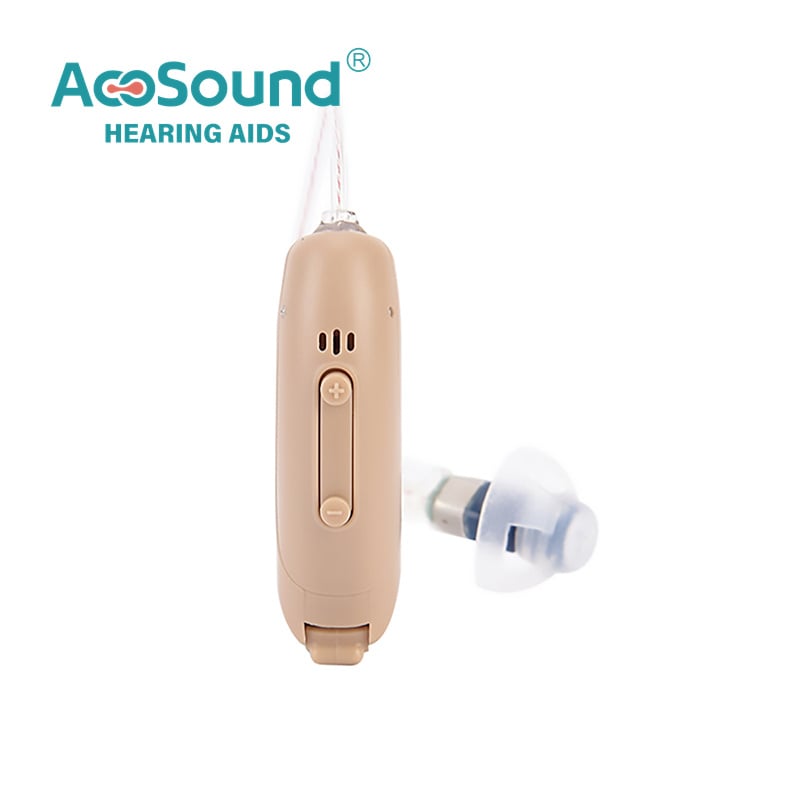
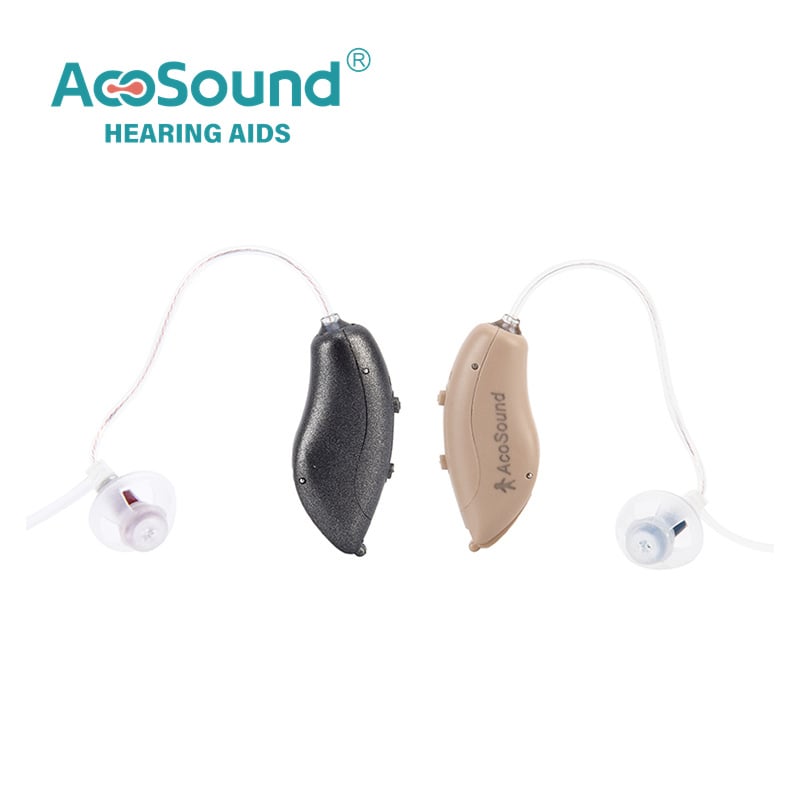
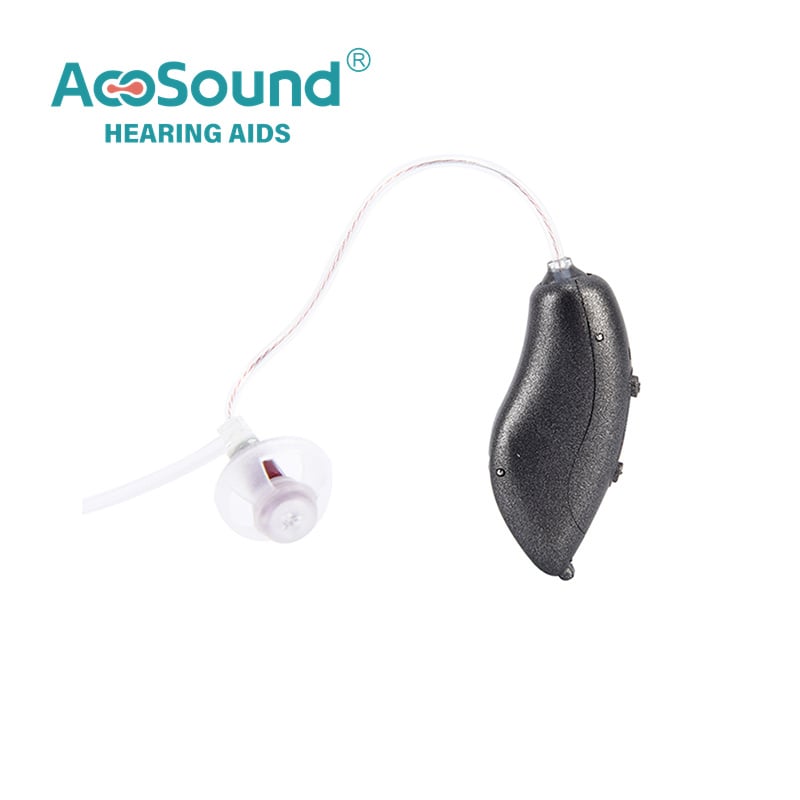
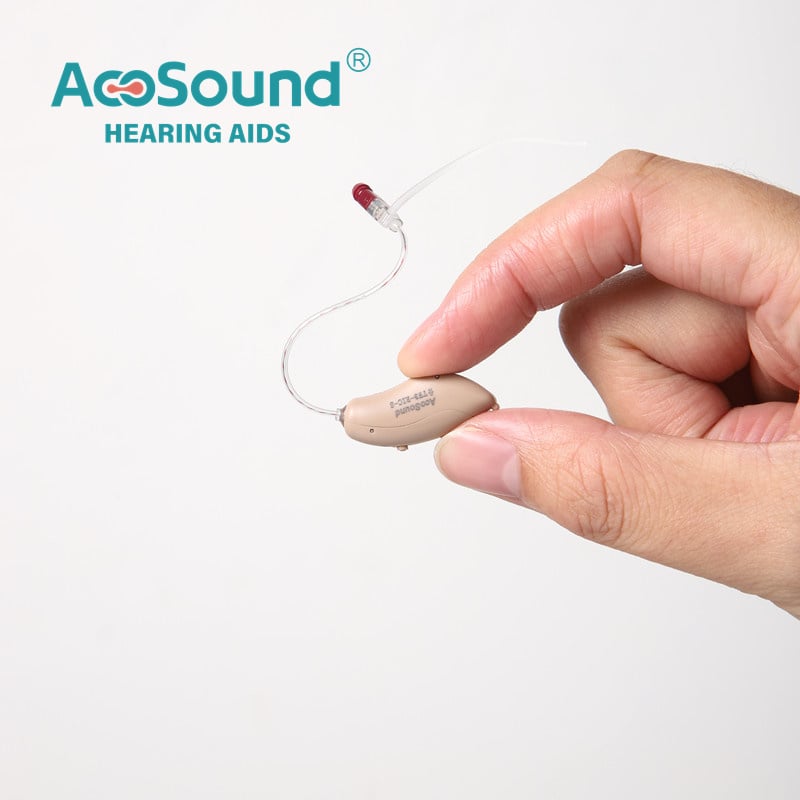
Product Overview
The L8-RIC-S is an 8 channel digital RIC hearing aid developed for distributors, audiology clinics, hearing centers and professional hearing care organizations that require more fitting capacity than the base L4 configuration while retaining a relatively streamlined environmental-processing structure.
The ACOD2101 intelligent multi-core DSP supports 8 independently adjustable compression and amplification channels, 16 independently adjustable bands and 32 DSP channels.
The model uses ERAC 1.0 Dual-Knee compression, DFBC 2.0 Adaptive Feedback Cancellation with two levels and SIW technology.
ENDR 1.0 noise reduction is specified at up to 17 dB, and Standard Transient Noise Management is included.
These features create an identifiable step above L4-RIC-S without moving into the Standard Environment Recognition and Wind Noise Management functions introduced in the higher models.
For B2B buyers, L8-RIC-S therefore fills an important intermediate role in the L-RIC-S family.
A Measurable Step Beyond the Base Configuration
The clearest progression in L8-RIC-S is the increase in fitting and DSP capacity.
The product provides 8 fitting channels, 16 adjustable bands and 32 DSP channels. Compared with L4-RIC-S, all three core figures double.
This increase gives fitting professionals more frequency-specific adjustment points while preserving the same ACOD2101 processor family and ERAC 1.0 compression platform.
For distributors, the 8 / 16 / 32 architecture is easy to communicate in product catalogs, technical training and professional sales discussions.
It creates a defined step between the 4-channel base model and the 12-channel configuration that introduces a broader environmental-processing package.
A Balanced Intermediate Product Tier
L8-RIC-S is designed to occupy the space between simple base-tier fitting and the Standard environmental-processing level.
This makes the model useful in a product portfolio where buyers need more than the lowest channel count but do not require Environment Recognition or Wind Noise Management.
The distinction is important for B2B product planning.
Instead of having two adjacent products that differ only by model number, L8-RIC-S can be presented through a combination of higher fitting resolution, higher DSP capacity, increased ENDR specification and Standard Transient Noise Management.
This gives professional customers several concrete criteria for model selection.
ERAC 1.0 and DFBC 2.0 Processing Foundation
The model uses ERAC 1.0 Context Analysis Based Intelligent Multi-Compression Technology with a Dual-Knee structure.
Feedback management is provided by DFBC 2.0 Adaptive Feedback Cancellation with two levels. SIW technology is also included.
These technologies remain consistent with the other L-RIC-S configurations, which helps maintain a unified technical foundation across the range.
For professional hearing care organizations, the shared platform can simplify product familiarization.
For distributors, it allows the differences between models to be explained mainly through fitting capacity and environmental-processing functions rather than by introducing a completely different signal-processing architecture at every tier.
ENDR 1.0 and Standard Transient Noise Management
L8-RIC-S uses ENDR 1.0 Environment Detection and Noise Reduction, specified at up to 17 dB.
This is higher than the 15 dB ENDR 1.0 specification of L4-RIC-S.
The model also introduces Standard Transient Noise Management, which is not included in the base configuration.
Environment Recognition and Wind Noise Management are not included at this product level. Their absence helps preserve a clear distinction between L8-RIC-S and L12-RIC-S.
For distributors, this creates a logical upgrade path: customers can move from essential noise reduction to transient-noise management and then to the broader Standard environmental-processing package available in the higher configurations.
Professional Fitting and Device Functions
L8-RIC-S provides four selectable programs and includes an Internal Sound Field Assessment and Internal Audiometer.
These functions support professional assessment and fitting workflows in clinics and hearing centers.
Additional operating functions include:
- Adjustable Turn-on Delay
- Occlusion Effect Management
- Low Battery Power Notification
- Adjustable Notification Volume
- Volume Control
- Memory After Power-off
- Standard Personalized Data Storage
- Nano Coating Technology
Together, these capabilities support professional fitting, assessment and ongoing device management.
Commercial Role for Distributors
For distributors, L8-RIC-S can serve as a practical transition SKU between the base and Standard-environment tiers.
Its main commercial differentiators are 8 fitting channels, 16 adjustable bands, 32 DSP channels, ENDR 1.0 up to 17 dB and Standard Transient Noise Management.
These are easy-to-verify technical points that can be used in sales materials without relying on broad subjective claims.
The model is particularly useful when a distributor wants to offer more than one base-to-mid-level choice while still maintaining clear differences between adjacent products.
By separating L8-RIC-S through fitting capacity and transient-noise management, the product family can remain easier for clinics and professional buyers to navigate.
Support for Tiered Product Planning
A structured product range is easier to manage when each SKU has a defined purpose.
L8-RIC-S supports that structure by providing a clear middle step.
It does not duplicate the streamlined role of L4-RIC-S, and it does not replace the Standard Environment Recognition role of L12-RIC-S.
Instead, it combines greater fitting capacity with a limited but meaningful expansion in environmental sound management.
For importers and hearing care networks, this allows product selection to be based on actual technical requirements, helping create a more coherent portfolio across different professional customer groups.
Technical Specifications
| Specification |
L8-RIC-S |
| Product Type |
Digital RIC Hearing Aid |
| Channels |
8 |
| Adjustable Compression & Amplification Channels |
8 |
| Independent Adjustable Bands |
16 |
| DSP |
ACOD2101 |
| DSP Channels |
32 |
| Compression Technology |
ERAC 1.0, Dual-Knee |
| Feedback Management |
DFBC 2.0, 2 Levels |
| SIW Technology |
SIW |
| Environment Recognition |
No |
| Noise Reduction |
ENDR 1.0, Max. 17 dB |
| Transient Noise Management |
Standard |
| Wind Noise Management |
No |
| Selectable Programs |
4 |
| Personalized Data Storage |
Standard |
| Max. OSPL90 |
110 dB |
| HFA OSPL90 |
106 dB |
| Max. FOG50 |
35 dB |
| HFA FOG50 |
30 dB |
| Frequency Range |
200–4500 Hz |
| Battery Current |
1.25 mA |
| THD at 500 Hz |
3% |
| THD at 800 Hz |
3% |
| THD at 1600 Hz |
3% |
| Reference Test Gain – Target |
30 dB |
| Reference Test Gain – Measured |
30 dB |
| EQ |
25 dB |
FAQ
How is L8-RIC-S different from L4-RIC-S?
It increases fitting channels from 4 to 8, adjustable bands from 8 to 16 and DSP channels from 16 to 32. It also adds Standard Transient Noise Management.
What is the specified noise reduction?
ENDR 1.0 provides up to 17 dB.
Does L8-RIC-S include Environment Recognition?
No. Environment Recognition is not included at this level.
Is Wind Noise Management included?
No. Wind Noise Management is not included in this configuration.
Which feedback technology is used?
The model uses DFBC 2.0 Adaptive Feedback Cancellation with two levels.
Contact AcoSound
Considering an 8 channel digital RIC hearing aid for your professional product range?
Contact AcoSound for L8-RIC-S specifications, samples and B2B cooperation information.
 EN
EN